11.30.2009

New Urban Arts Opening Recap

Now that the holiday is over, updates, updates!

Had a fabulous time at the opening at New Urban Arts! The whole day kind of made me feel like I was seven again, and it was my birthday - at work everyone kept coming up to me and asking "Are you excited? It's your big day!" SO MANY people came from the Museum, from book club, from my life to check out the show and the wonderful new community that I'm a part of. When it was all over, I got home feeling so overwhelmed that I collapsed on the couch and 7:30pm and proceeded to sleep for 12 hours. Again, I felt like a seven year old coming down after an awesome birthday party. I can't remember the last time that I felt that way.


All of the artist mentors wore these corsages that my students and I made. We busted them out assembly-style and they looked great!


The award that NUA received was called "Coming Up Taller." So everyone was invited to mark their height in the studio, and we all got stickers that said "I'm Taller!"


So many wonderful women from our women-who-work-in-non-profits-focusing-on-art-education-and-community profesh development book club. All this time, and we still haven't found a better name for it!


And of course, my partner in crime, Adj. In all of the excitement and warm fuzzy feelings, I completely forgot to take photos of my display. Ooops!


The weekend was full of craftiness as well - Adj stumbled upon this old set of silver. (And by stumbled upon, I mean that it's been in the back seat of Ian's car for longer than we've been dating...) She was excited and inspired by the wooden handles. Can't wait to see what comes out of this set!


I finished up some more inventory (see how patient I'm being...hmm??) - lots of wonderful wallets made from my favorite vintage fabrics and buttons from grandma's button box!


And on Sunday I had two craft dates. Erica has been wanting to come down from Boston to craft together for a while now. She brought a big, wonderful box of braided rug supplies from her grandmother's attic, and started her own rug for her house.


And Liz came over to try out these beautiful chandeliers that we've been dying to make with some leftover office supplies!

Keep on the lookout for a new Recycled Project Tutorial this week! Carole Ann

11.22.2009

Recycled Projects: Thanksgiving Nostalgia

Pilgrim Place Card

Adj and I were feeling nostalgic about Thanksgiving crafts from our youth this week. For me, this was the pilgrim hat place settings that my mom and I made when I was little. We've saved and used the same ones each year, and when there's a special guest or a new addition to the family we always need to make a few more.


All you'll need is a scrap of black paper about 4.5" x 7" (construction paper or card stock will work), some scissors, a black marker, a glue stick, and a small scrap of white paper (I used an envelope from something I got in the mail this week). Fold your black paper in half hamburger-style and draw the outline of the pilgrim hat on one side. Cut along your outline through both layers. Cut a scrap of white paper to form the band of the hat and glue it on. Write your guest's name with the black marker and you're done!

Indian and Pilgrim Egg People

It had been along time since I had thought about family traditions but as Carole Ann and I talked about past times I was reminded of the many crafts that filled my childhood. The one that always occupied our thanksgiving holiday season was the creation of egg people. I first remember making these characters when I was about 7 and my mom at the time was my age now 25! As a single parent of three my mother never had a lot of money to purchase craft supplies but would teach us to craft things from whatever we could find around the house.

You Will Need
  • 4 eggs (2 brown 2 white)
  • 2 toilet paper rolls
  • brown paper bag
  • constriction paper
  • Thumb tack
  • scissors
  • glue
The first step is to hallow out the eggs. Shake the egg quickly to break the yolk inside. Carefully poke the thumbtack into each end of the egg. I like to make the hole in the pointed end of the egg bigger so that when you blow into the egg the insides will come out easier. The end with the larger hole will be hidden inside the egg base.
Slowly begin to forcing air into the egg, through the hole in the top, this will force the egg insides out the bottom into your container. Be PATIENT this could take a while especially if the yolk has not broken. Don't forget to save the eggs for breki tomorrow morning. : )

Once the egg is hallow run some water from the tap through the egg and blow it out. This will prevent your egg people from stinking like rotten eggs. Set the eggs to dry upright on the paper towel. I leaned them against the counter wall this will ensure the water inside leaks out.


Now that your eggs are hallow you can begin to create the bodies. You start off with the toilet paper rolls these will serve as the body/ base for the eggs to sit in. Cut the rolls into 1 and 1/2" inch rings. You will need 5. There will be 4 for the bodies and one for the mans pilgrim hat.

Next you will cut out 4 pieces of paper 3" wide and about a half inch longer than the circumference of the toilet paper roll. I used a brown paper bag for the Indian bodies and black construction paper for the pilgrim bodies. Cover the toilet paper roll in glue and place in the center of the paper rolling untill it is completely covered.

Once the base has dried for a short while you will need to make cuts into the paper from the edge to the where the toilet paper roll and paper meet.
After the cuts have been completed line the inside of the flaps with glue and fold them inside the toilet paper roll.
While the 4 bodies are drying you can begin to create the accessories. You will need to cut 4 orange 1/4" strips of paper 2 for belts and two for head bands for the Indians. For the Pilgrims you will need to cut 2- 1/4" white strips for belts and 2 -1/2" x 1/2" and yellow squares for belt buckles. Glue the belts and to the centers of each base. Add the belt buckles for the pilgrims.

With your remaining two orange strips create two circles that will fit atop the eggs and serve as headbands. Next you will need to create the feathers. The ones pictured here are about 1 and 1/2" tall and 1/2" wide. After shaping them you can cut tiny slits in the edges to give it more of a feather look as I did here and glue them to the inside of the headband.

The pilgrim accessories will take a bit of time but are well worth the work. You will need to create the pilgrim hat next. Using a peanut butter jar trace a circle onto a cereal cereal box and a black piece of constructions paper. Cut them out and glue them together. The cereal box base will give the hat enough structure to hold the hat top.

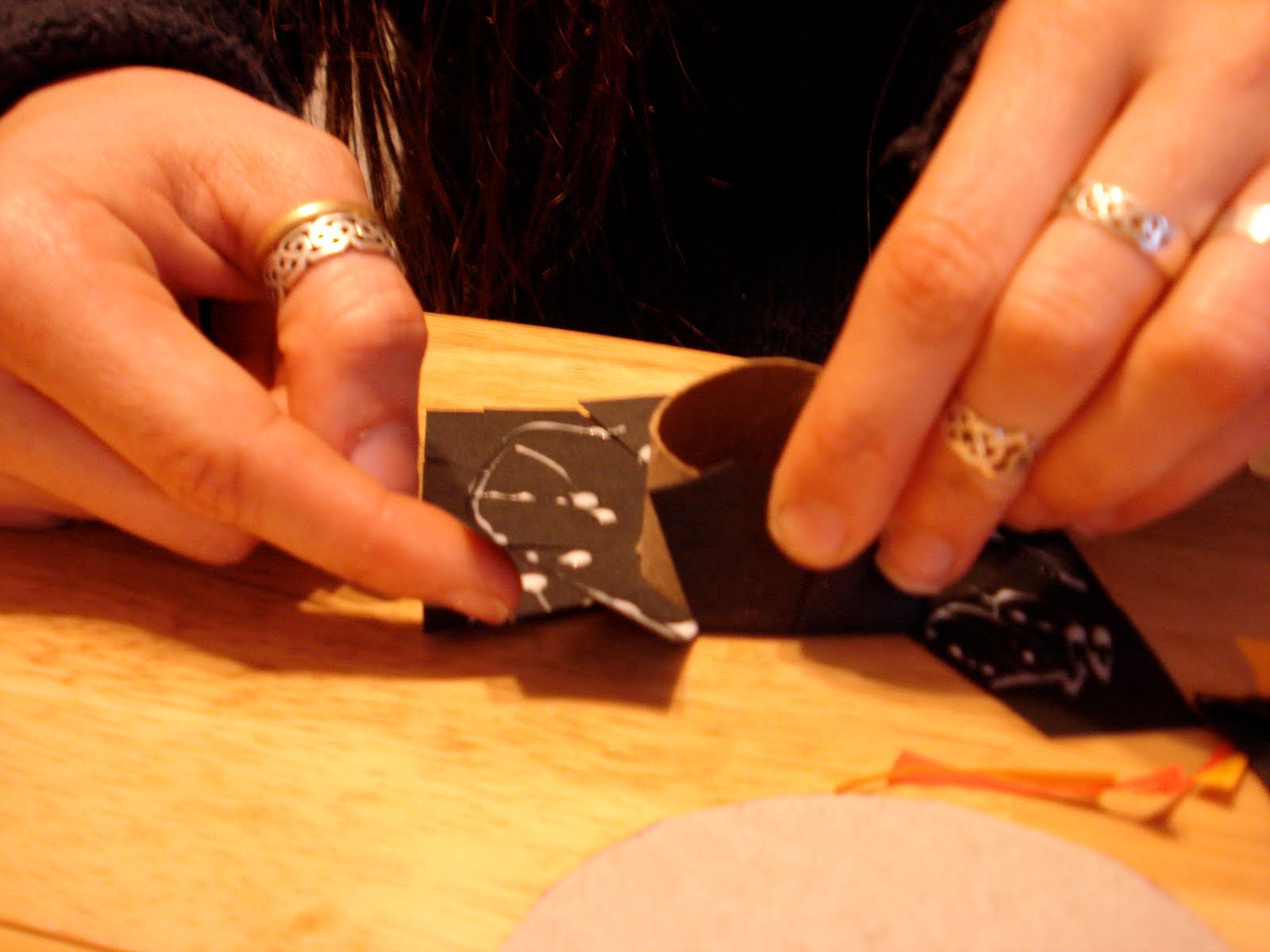
Using the 5th toilet paper ring place it in the center of a 4" square piece of black paper and make cuts about a half inch apart from the edge up to the ring.

Placing glue on all the flaps fold each one around the sides of the ring and into the inside - one after another. While the hat top is drying cut a hole in the center of the hat base. This hole will allow you a way to secure the hat to the egg head. The pilgrim egg head will poke into this hole and will hide under the at top.

Once complete glue the hat top to the hat base covering the hole.


The final accessory you will need is the pilgrim bonnet. Using a white piece of paper about 3" wide and 4" long make a half inch fold in the right side of the paper. Next make 1 and 1/2 " cuts toward the center about an inch from the left side.

Fold the back flap around the side of the bonnet and glue it so that the edge is securely under the bonnet rim. Do this on both sides.

Assembly time! Take your dried eggs and glue them to the body base.

Next glue all the head wear accessories to the eggs.

Finally decorate with fine point sharpies as I did below to create faces hair and jewelry.

These little guys make great gifts. I am not a cook so any time that I have joined others for thanksgiving dinner I have brought a set of these along as my humble peace offering for not cooking a dish. They make great table centerpieces and if packaged safely can be reused year after year.
We hope that our thanksgiving nostalgia has inspired you to create something new or from you own past that you can share with others.

Good Luck and Peace
Adj and Carole Ann


11.15.2009

Writing an Artist Statement...eek!

So, on Friday my work will be exhibited in my first gallery show ever (!) at New Urban Arts. They are putting together a showcase of all of the Artist Mentors' work, and to celebrate the fact that they are officially one of the top 15 youth arts programs in the country (as declared by Michelle Obama last week!).

I've gone back and forth in choosing what I should show. Should I make something new? Should I hurry up and finish that quilt? What of mine would look good on a wall? I understand how the photography mentor and watercolor mentor will exhibit their work, but am I just going to hang a bag on the wall? My work is meant to be used and worn, not necessarily hung up.

{ travel tissue holders...sniff sniff! }

Okay, I'll say it: I'm a little intimidated by the other artist mentors. Since I'm new to being an artist (or at least calling myself one) and sharing my creative work, I feel very much like I don't know what I'm doing, or that any moment someone is going to jump out and say "Ha! You're not a real artist! You're just faking it!" I think is part of that whole thing Adj and I are struggling with in allowing ourselves to call ourselves artists. Am I good enough? Does my work belong with theirs? What does it mean to be an "artist," anyway?

After torturing myself with questions and talking with a few students and friends, I've realized that there are no rules for this exhibition - my assignment is to introduce my creative practice or how I practice being creative to the community. It should be anything that feels natural to me and my work. I need to quit worrying about whether I'm good enough, whether I fit in, and just be myself. It's so obvious, but such a difficult thing. This whole situation made me think of when I started as a freshman in college. I walked around campus for at least the first two months feeling like I didn't belong - "But these people are so smart! They're Brown students!" I decided to take a writing class to try to get up to speed with everyone else. About three months into that class, I realized that everyone else in my section were jocks, and that I was a fine writer. In fact, it's one of my better skills. I just needed to trust in myself. Not so easy.

{ hair clips }

So, I've decided to show some things that I've already made, and that I already use, since that's a big part of my work - useable stuff. I'll show a bag, an apron, coin purse, fused plastic wallet, and earrings. Phew. Okay, done. Choice made.

My next task is to write an artist statement. I've never had to do this before, and it feels both funny and natural at the same time. "Artist statement." Doesn't that sound pretentious? Adj said that it's just all the things that we're usually thinking about all the time. Really, I'm always reflecting on the "why" behind my work. So I just started making a list:

I like transforming common objects, trash, whatever I have around me – plastic bags, milk cartons, old wallpaper, my boyfriend’s worn-out pair of jeans, grandma’s box of buttons, fabric scraps – into completely new things.
I like to make things that I can use and things that I can wear.
I like using vintage-y fabric.
I like when you can see the thread.
I like the process of figuring out the order of steps I need to go through to make my pattern come out the way I envisioned.
I like it when it doesn’t come out the way I envisioned, but instead surprises me as something a little different.
I like it when my sewing machine, “Silas”, behaves (which is most of the time).
I like it when hand-sewing doesn’t take too long, because sometimes I’m not very patient.
I like it when people come over to my house to be crafty with me – I think creating is both more fun and easier when it’s done as part of a community.
I like not making too many of any one thing, because I think it’s boring and I start feeling like a robot.
I like thinking about the things that my grandmother and my mother have crafted, and the fact that they’ve taught me so much about sewing.

I think that kind of sums it up. Any feedback? I welcome your comments! And if you're in the Providence area, I welcome you to the opening on Friday from 4-7 at New Urban Arts, 743 Westminster Street!

Carole Ann

11.08.2009

Art & Patience

Patience. This is something that is definitely not in my genes. When I was little, whenever my dad went away for business he would bring a little something back for my brother and I. One time he brought us back these little rocks with a word written on each - mine said "Patience." At the time, I think I took it as a bit of an insult, but these days I'm very aware of how I constantly need to remind myself to be patient.

Like my mom, I like to be busy - it's hard for me to just sit and do nothing (in fact, I'm incapable of this - just ask Ian). I have to be busy with my hands, crafting, making a list, somehow feeling like I'm moving things along. At work, I barrel through my to-do list so much that I wrote "PATIENCE" above my computer so I'm reminded to SLOW DOWN!
Nowadays, I'm needing to be especially patient at work because my head is brimming with creative ideas - I have to try this, I have to try that, I need to make this, what if it was with this fabric, could I try that, can I do that with my machine...but I have to wait until I'm home to follow through on anything. I end up coming home with 5 lists of ideas in my planner because that's all I can do to move my art forward during the daytime.

And then when it comes to creating the actual projects, I also struggle with patience. I can easily work through the entirety of Sunday on a single project, forgetting to get dressed or even to eat. But once I finish making one of something, I'm ready to move on to the next project. I rarely make the same thing twice because I feel impatient to try new things, build my skills, keep moving forward. This is a problem when it comes to creating some inventory to sell. If I start to make a "batch" of something, I start to feel like a robot, not an artist. I remember pumping out 60+ milk carton coin purses for the Providence Art Festival...it got old pretty fast. I guess that says that art-marking is more about process than product for me. But product = profit, right? I'm trying to split my time now between inventory and new projects (I made a priority list, of course), but time is so, so limited!

Knowing that this is something that I need to work on, I'm giving myself a little "patience challenge." I was inspired by Sew, Mama, Sew!'s Scrap Buster Month projects - especially Sew Take a Hike's "A Little Help From My Friends" Quilt. I've never truly made a quilt before. I think the patience thing has been a bit of a road block for me. So, as you can see in the photo above, I've started work on my own scrap quilt. Little by little, I'll get there. This one will probably take a few months. It's almost painful for me to write that. But I'm going to be patient! True to the spirit of the tutorial, I got a little help from friends to get this quilt started - Tiffani at work helped me to cut the paper squares for it, and one of my students at New Urban Arts especially encouraged me to take on a project that requires lots of patience. We'll see how I do. Any tips?

Going along with the patience theme - just like corporate America wants me to feel, I'm impatient for Christmas! I made this Christmas apron from a scrap bag of fabric that I got at good will. I'll be posting up a tutorial on Wednesday, so come back and check it out!

Carole Ann

How To: Christmas Apron

There's a story behind this apron - back in July I went to my favorite good will store in VT, SEVCA, and discovered that they have a sewing section! They had big bags of different fabrics grouped together, and I scored a whole bag of Christmas fabric for $2.00. Last week I really wanted to make a tree skirt, but I couldn't find a good pattern out there (anybody know of any???), so I decided to make one up myself. So, it needed to be a circle, and I started drawing and soon realized that math was in order. Thanks to the freedom of Brown's open curriculum, I haven't taken a math class since high school. But Adj and I put our heads together and did all of these calculations about the circumference of the big circle and inner circle and how many panels of different fabrics I would need in order to complete the circle. Confident in our calculations, I started cutting the panels out. After about a half an hour, I realized that we were way off, and decided to abandon the tree skirt idea for another day. Instead, Adj and I decided that the panels I cut out would look great as an apron - yeah, an apron! A pretty, math-free apron!

Anyways, the moral of the story is - get out there and find a grab bag of lots of fun fabric at your nearest good will store, and make a lovely apron! Oh, and never ask Adj and I to figure out a math problem. Yikes!


Good Will Grab Bag Christmas Apron

You will need:

Scraps of Christmas-y fabric, at least 24” long and 6.5” wide for the front and pocket

¾ yard of fabric for the back, bias, and strap

Paper to make your pattern out of (I used my go-to pattern maker: the JC Penney flyer!)

Cutting mat and rotary cutter

Scissors

Thread (I recommend red or green!)

2” Bias Tape Maker (will make it faster, but can do without it)

Iron

Sewing machine


1. Make your pattern for each of the triangular-ish panels. I drew a shape on the JC Penney flyer that is 24” long, 6.5” wide at one end, and 1.5” wide at the other.

2. Use your pattern to trace and cut out five of those shapes – you can use five different fabrics, or choose only a few to work with. It’s up to you! Iron your panels and set them out to determine the order you want them to be in.

3. Sew the panels together. Start at one side and pin two panels right sides together along the long 24” side. Sew with a ¼” seam allowance.

Add the next panel, right sides together, and repeat until all five are sewn together. Iron the seams flat.

You might notice that the final shape is really skinny on the top and much wider on the bottom – don’t worry, we’re going to shape the top of the apron in the next step.


4. Measure down from the middle of the top of the apron 6.5” and mark a line straight across all five panels at this point. Use your cutting mat and rotary cutter to cut along this line. This will leave the body of the apron to measure 17.5” straight down that middle panel.


5. Use the top piece that you just cut off to make the pocket. Pin the two ends right sides together and sew ¼” seam down the edge.

Turn the tube right side out and flatten it however you would like so that three or more of the panel patterns are showing. This piece forms the pocket on one side and the pocket lining on the other.

Use your cutting mat to even out the tops and bottoms; it will form a triangle-ish shape that is reminiscent of the apron itself, only upside down! My final pocket measured 5” tall, 5 ¾” wide on top, and 3” wide on the bottom.


6. Next, make the bias tape that will form the perimeter of both the apron and the pocket. Cut a 2” wide strip of the contrasting fabric at least 85” long. (You’ll probably need to attach a couple of strips together to make a strip this long.) Use the iron and bias tape maker (or just fold the fabric) to make the .5” wide bias tape. Make sure you have some good music playing, because this will take a few minutes and a little patience.

7. Wrap the bias around all four edges of the pocket and sew 1/8” all around the inside edge.

8. Place the pocket wherever you want it on the apron. Pin and sew around the sides and bottom (3 sides) 1/8” from the outside edges.

9. Now you’re ready to cut out the back of the apron. Place the front of the apron on top of the back fabric with wrong sides together (as in, how the final apron will look). Trace around the edge of the apron, and cut out the back.

Pin together around all four sides (still wrong sides facing each other) and baste stitch around so the two sides are attached.


10. Attach the bias around the sides and bottom of the apron (3 sides), sewing 1/8” seam.

11. Make the apron strap. Cut a 3” wide x 70” long strip of that contrasting fabric (same as back and bias). Again, you might need to attach a few strips to make a strip this long. Fold the strip in half long-ways (so it’s 1 ½” wide) and make a crease with the iron (barely visible in this photo). Unfold and iron ¼” under on each side of the crease, so in the end it will be 1 ¼” wide (again, barely visible).

12. Attach the strap. Find the center of the strap and the center of the top of the apron. Line them up and begin pinning the strap so it sandwiches the apron (just like with the bias tape. Continue pinning the ends of the strap so you’re ready to sew along the entire length. Start on one end of the strap, sewing 1/8” seam to close the end of the strap, the side, attach it to the apron, and continuing on to the other side and end.


You’re done! Be prepared to bake some Christmas cookies in style!

More recycled projects to come - any requests?

Related Posts with Thumbnails